
PROPELLER ENGINEERING
Rake Angle: Why Propeller Blades Lean Aft
Leaning the blades aft gains tip clearance without reducing diameter. The clearance gained with 8° rake, a worked example and what to watch at the rudder.
- PUBLISHED
- READING
- 3 min
- AUTHOR
- Eriş Pervane Mühendislik
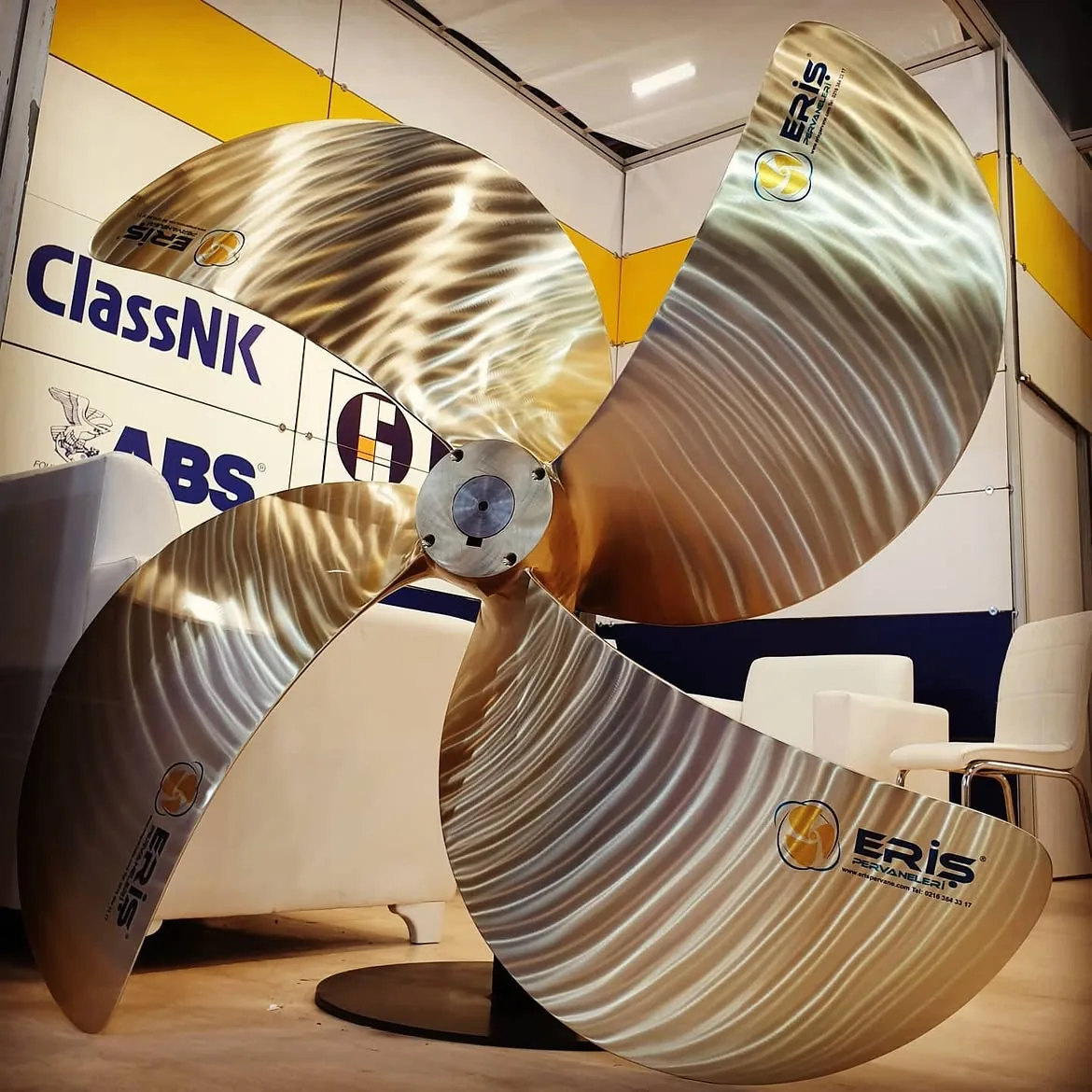
In our clearance article we discussed how much room a propeller needs to the hull. But what if the aperture is tight, draught is limited and you do not want to reduce the diameter? One of the simplest tools in propeller design then comes in: rake, the aft lean of the blade.
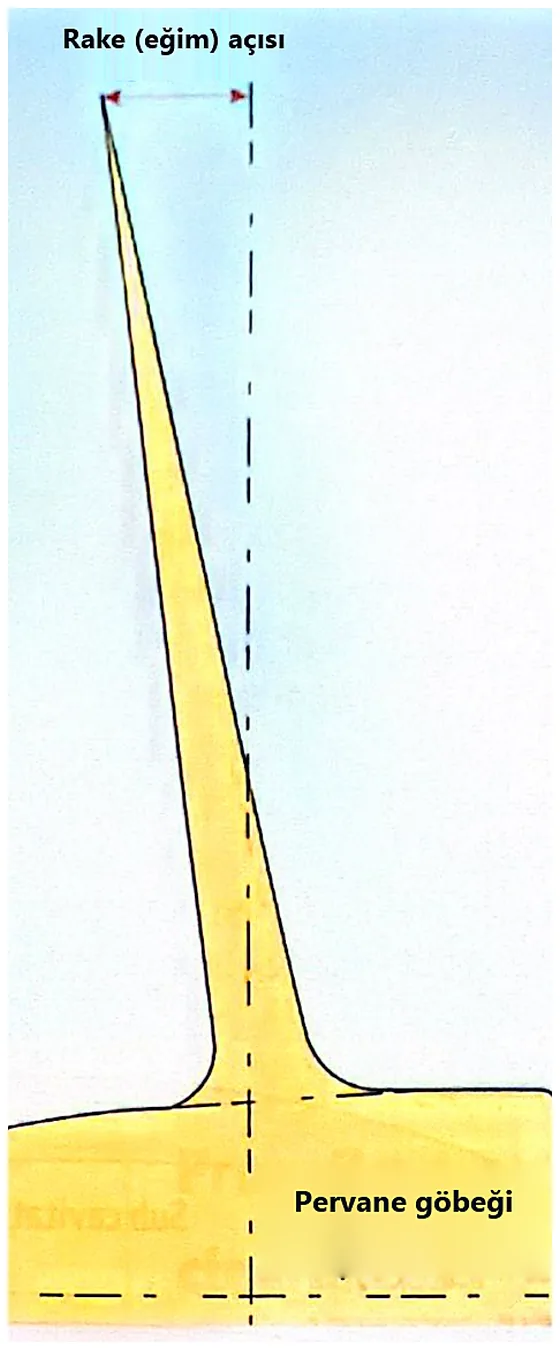
What is rake?
Look at a propeller from the side. If the blade rises straight up from the hub, rake is zero. If it leans aft towards the tip, the angle between the blade axis and the vertical is the rake angle. A raked blade tip moves aft and, on most hulls, under a higher part of the hull.
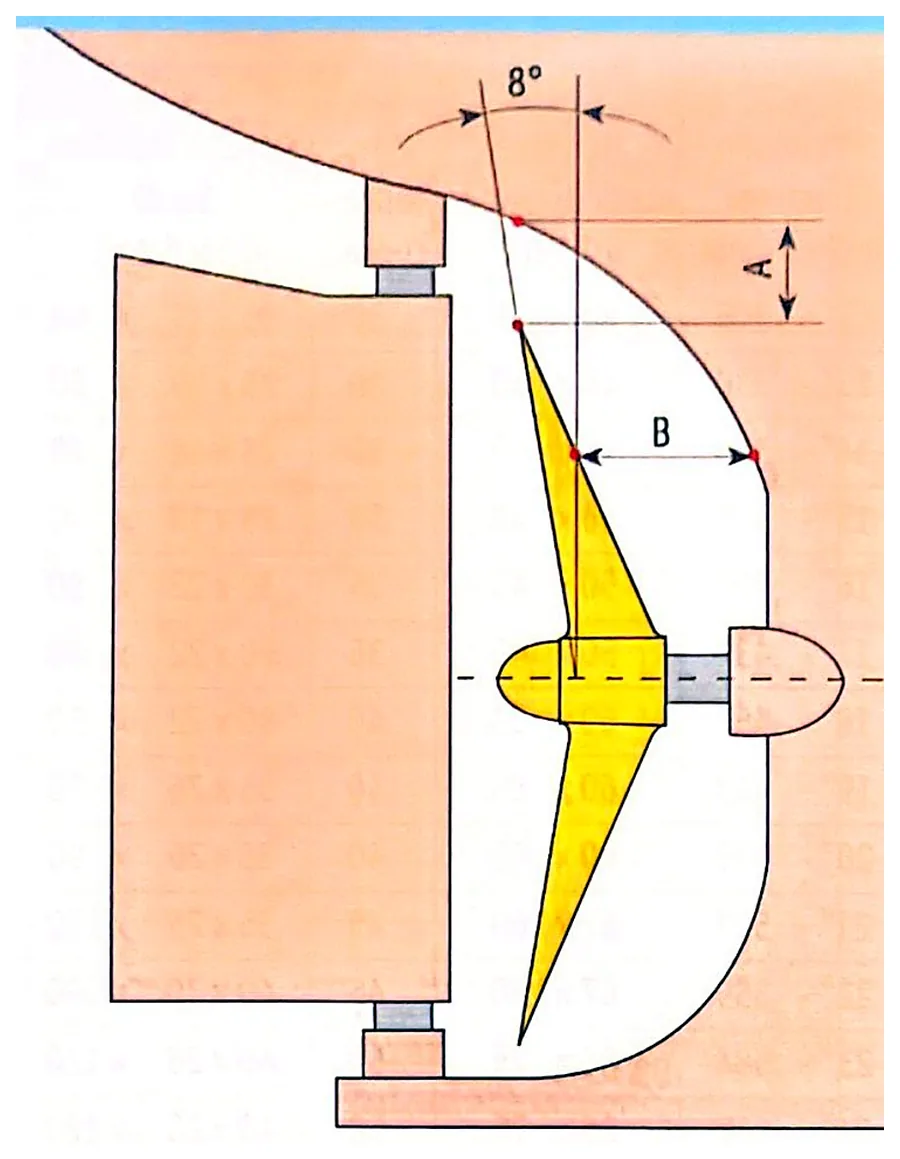
What rake gains
The main purpose of rake is more clearance, and with it smaller pressure pulses into the hull: less vibration and noise, less erosive cavitation near the hull, smoother inflow and slightly more speed and efficiency. A minimum clearance of about 15% of the diameter is usual, and 20–30% gives good results; rake is the way to approach those values without shrinking the diameter.
How far does 8° move the tip? A worked example
8° rake is a common standard on quality propellers. For an 800 mm propeller (radius 400 mm, hub radius about 60 mm) the blade is about 340 mm long. Raked 8°, the tip moves aft by
340 × sin 8° ≈ 47 mm
while it drops only 340 × (1 − cos 8°) ≈ 3 mm, so the diameter is practically unchanged. On a hull rising towards the stern, that 47 mm puts the tip under a higher part of the hull, often gaining tens of millimetres of vertical clearance.
Watch the rudder
The price of rake is that the blade comes closer to the rudder, 47 mm in the example. Always check:
| Check | Target |
|---|---|
| Blade tip to hull | ≥ 0.2 D, preferably 0.3 D |
| Propeller to rudder leading edge | ≥ 0.2 D |
| Blade tip to keel shoe | ≥ 0.04 D |
If rudder clearance is marginal, reduce the rake or rearrange the rudder-to-shaft distance, keeping maintenance needs such as withdrawing the shaft without removing the rudder in mind.
Rake and skew together
Rake leans the blade aft seen from the side; skew curves it against the rotation seen from ahead. One adds clearance, the other spreads the load transition. On boats where quietness matters both are used, and 30° skew with 8° rake is a well-known balance.
Rake does not change the diameter; it moves the propeller away from the hull.
Send us your aperture dimensions and current propeller data through the contact page and we will review diameter, rake and blade count together.