

Engineering · Manufacturing · Service

Marine Propeller Technical Guide

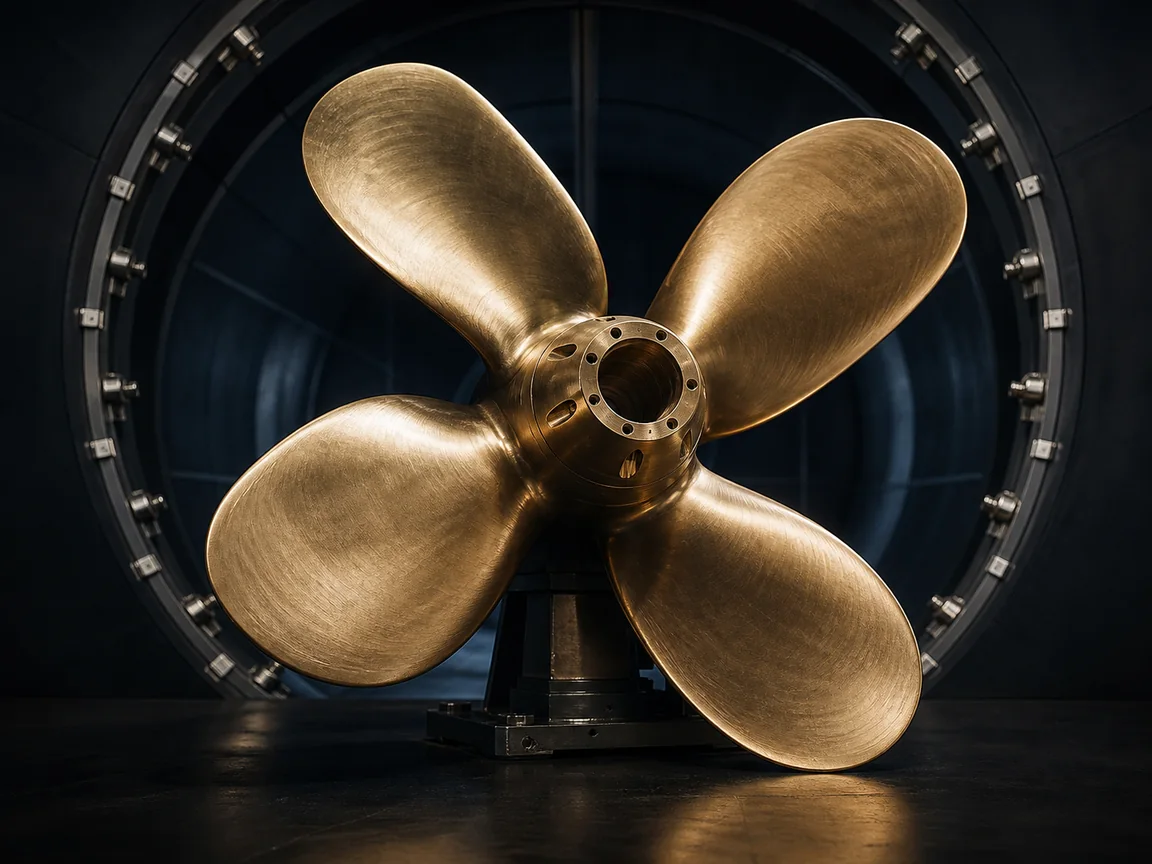
The right propeller is the result of evaluating the vessel, engine, gearbox and real operating profile together. Explore the key terms, product programme and decisions that lead to manufacture.

2–6Blade fixed-pitch propeller production
100–2500Millimetre project-production diameter range
7 / 28Standard series / technical model entries
50+Years of marine manufacturing experience
01 — The right starting point

Propeller selection is not one dimension

The performance of a ship or boat propeller cannot be explained by diameter or blade count alone. Vessel type, length, beam, draft and displacement; target service speed; engine power and rated rpm; gearbox reduction; shaft rotation; available aperture and the duty cycle are parts of one engineering problem. A fishing vessel that prioritises thrust does not share the same design priorities as a high-speed craft approaching cavitation limits.

These inputs allow diameter, pitch, P/D ratio, blade number, developed blade-area ratio, rake and skew to be assessed together. Missing or estimated data may produce an engine that cannot reach rated rpm, overload, vibration, higher fuel use or insufficient thrust. The Propeller Calculator provides a preliminary result; the result should still be reviewed against verified project data before manufacture.

Core information for an engineering quotation

Vessel type and dimensions, displacement, engine make/model, power and maximum rpm, gearbox ratio, shaft rotation, current propeller diameter–pitch–blade data, target speed and the vessel's dominant operating condition.

03 — Essential terms

Diameter, pitch and blade geometry

Reading a technical table correctly helps explain why two visually similar propellers can behave differently. The parameters below are not independent: changing one can require the other values and the expected vessel response to be reassessed.

Diameter
The diameter of the circle swept by the blade tips. It affects thrust capacity, tip speed and the physical clearance required under the hull.
Pitch
The theoretical distance travelled in one revolution with no slip. It must be evaluated with engine loading and achieved rpm.
P/D
The pitch-to-diameter ratio. It helps compare the geometric loading character of propellers with different diameters.
DAR
Developed blade area divided by propeller disc area. It is closely related to cavitation margin, load capacity and blade number.
Rake
The axial inclination of the blades relative to the propeller plane. It influences clearance, loading distribution and hydrodynamic behaviour.
Skew
The circumferential sweep of the blade form. It can influence load transition, vibration and noise behaviour.

Find model-specific diameter, P/D, blade-area ratio, rake, skew and ISO 484 Class II tolerance data on the propeller model page. Hub, taper, keyway and shaft dimensions are available in the technical dimension tables.

04 — Material and production

From calculation to a balanced product

Manganese bronze and nickel-aluminium bronze (Nibral) are evaluated against strength, corrosion behaviour, castability and repair requirements for marine propellers. Material is not selected by appearance: diameter, loading, service environment and the project specification all matter.

The Eriş workflow starts with engineering and CAD/CAM preparation, then continues through pattern and mould work, casting in an electric furnace with up to 2500 kg capacity, CNC machining, finishing, dimensional inspection and static balancing. Product geometry and the required tolerance class are confirmed before manufacture according to project scope.

Project data

Vessel, engine, gearbox and operating targets are verified.

Design

Diameter, pitch, blade geometry and material pass engineering review.

Manufacture

Pattern, mould, casting, CNC machining and precise finishing are applied.

Inspection

Dimensions, surface, pitch distribution and static balance are checked.

05 — Service decision

Repair or replacement?

A bent blade, missing edge, crack, impact, corrosion, cavitation mark, pitch inconsistency and balance error do not receive the same treatment. It is not responsible to declare a propeller repairable—or condemn it—before considering the material, damage location, extent and previous repair history. Visual inspection should be supported by dimensional measurement, crack inspection, pitch checking and material assessment when needed.

Suitable damage may be addressed through correction, welding, re-machining, finishing and balancing. When structural integrity or target geometry cannot be recovered with confidence, replacement is the safer route. Review the propeller repair and maintenance process or send photographs and verified project information for an engineering assessment.