
PROPELLER ENGINEERING
Propeller Tip Speed: What the 35 and 40 m/s Limits Mean
The speed at which the blade tip travels through the water decides noise, cavitation and which alloy can be used. Tip speed calculation, a limit table by diameter and rpm, and a worked gearbox example.
- PUBLISHED
- READING
- 4 min
- AUTHOR
- Eriş Pervane Mühendislik
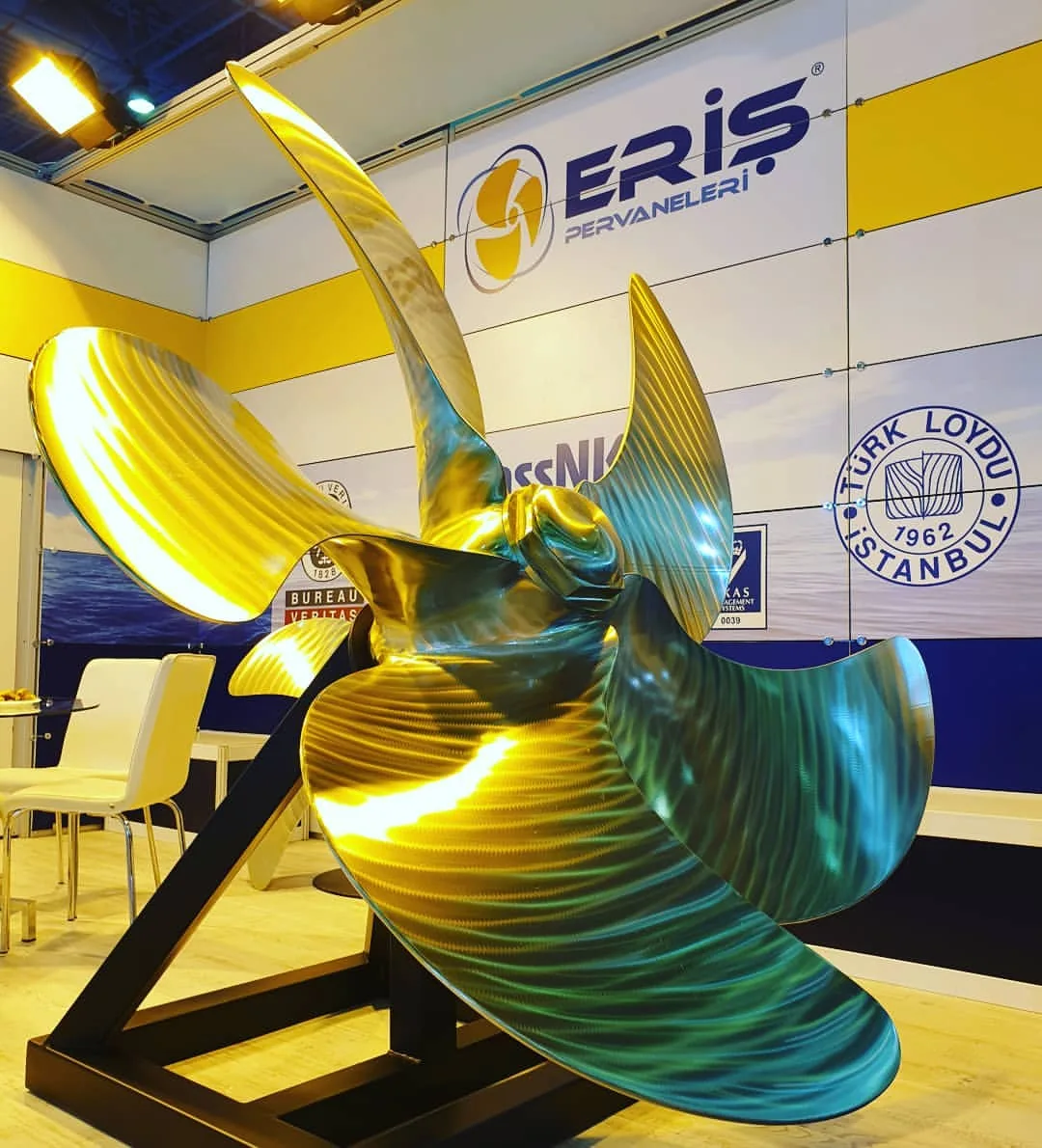
When choosing a propeller we usually look at diameter, pitch and blade count. Yet the combination produces another value that directly decides both noise and material life: tip speed. The blade tip is the fastest point of the propeller in the water, where pressure drops most and where cavitation usually starts first.
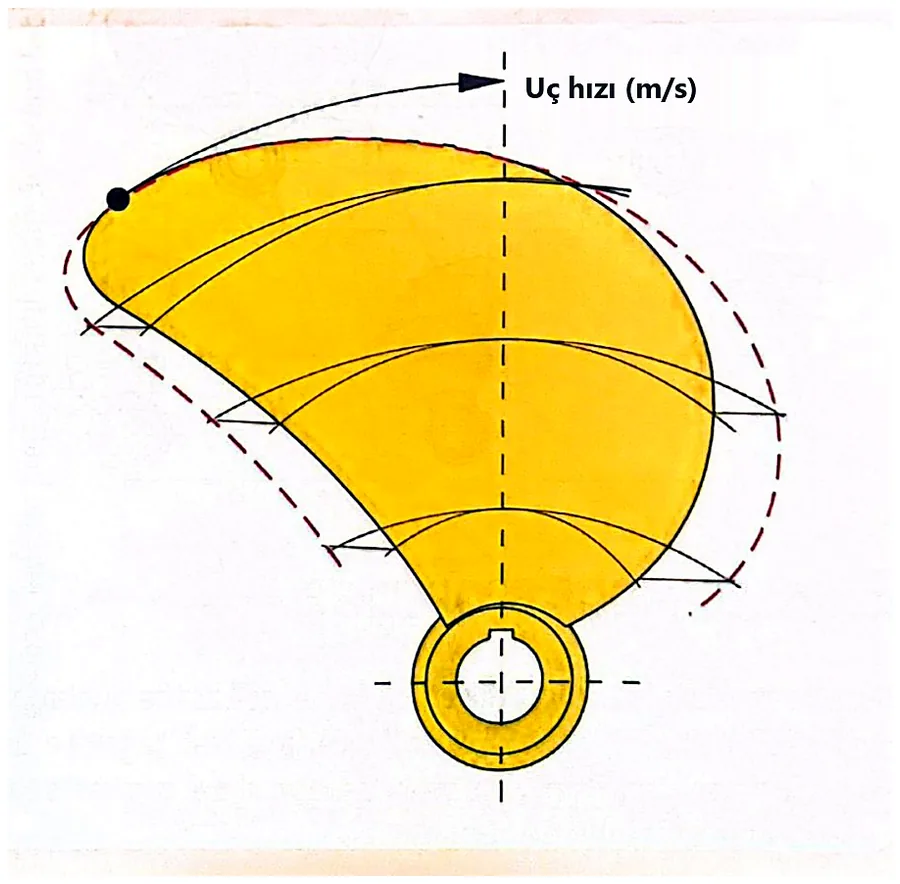
How tip speed is calculated
v = π × D × n / 60
- v: tip speed (m/s)
- D: propeller diameter (m)
- n: propeller rpm = engine rpm ÷ gear ratio
Forward speed is left out; the circumferential speed is what matters, and practical limits are set on it.
Three important thresholds
| Tip speed | Meaning |
|---|---|
| Below 35 m/s | Low risk of cavitation noise on displacement hulls |
| Above 35 m/s | Cavitation becomes an annoying noise source |
| 40 m/s | Upper limit for manganese bronze propellers |
| Above 40 m/s | Common on semi-planing and planing boats; nickel aluminium bronze is required |
Predicting the extent and type of cavitation is difficult, so on displacement hulls the safe course is to keep tip speed below 35 m/s. On fast boats exceeding 40 m/s is often unavoidable, and then manganese bronze is no longer adequate: above that speed there is a real risk of material particles being torn from the blade tip. Use stronger, more erosion-resistant nickel aluminium bronze (NiAlBr).
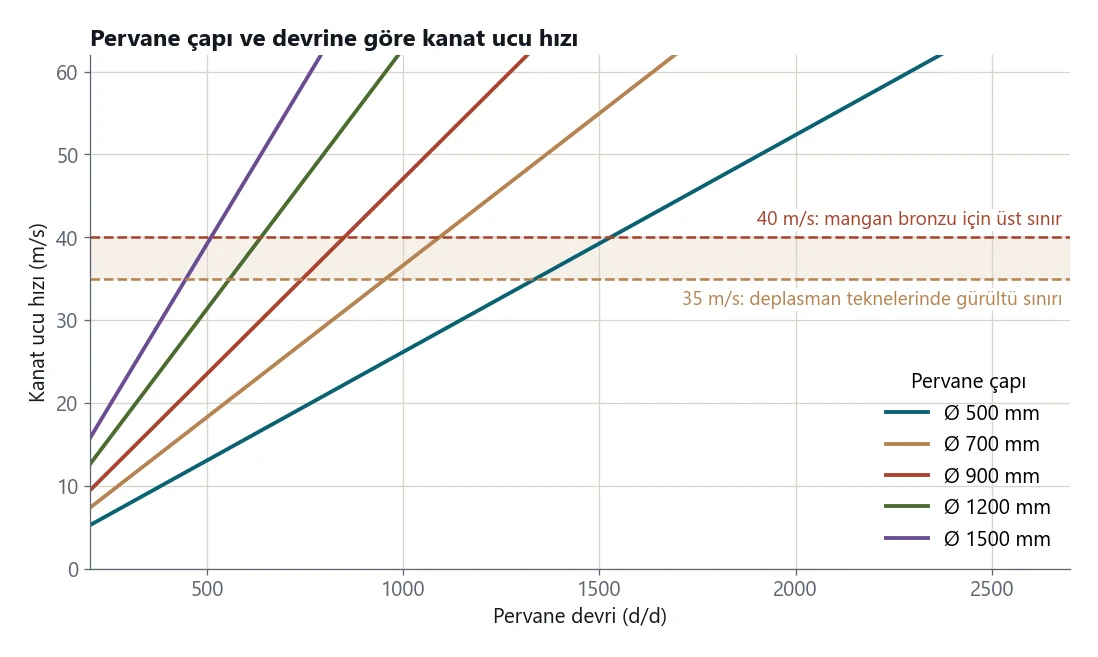
Maximum propeller rpm by diameter
| Diameter | Max rpm at 35 m/s | Max rpm at 40 m/s |
|---|---|---|
| 500 mm | 1337 | 1528 |
| 600 mm | 1114 | 1273 |
| 700 mm | 955 | 1091 |
| 800 mm | 836 | 955 |
| 900 mm | 743 | 849 |
| 1000 mm | 668 | 764 |
| 1200 mm | 557 | 637 |
| 1500 mm | 446 | 509 |
Example: how the gear ratio changes tip speed
An engine gives full power at 2500 rpm and a 700 mm propeller is considered for a displacement boat.
- With 2:1 the propeller turns 1250 rpm:
π × 0.7 × 1250 / 60 ≈ 45.8 m/s, above both the noise and the manganese bronze limits. - With 2.5:1 it turns 1000 rpm: about 36.7 m/s, acceptable for manganese bronze but still above the noise limit.
- With 3:1 it turns 833 rpm: about 30.5 m/s. Lower rpm allows a larger diameter and pitch and usually better efficiency.
The right reduction ratio is the most effective way to bring tip speed within limits, but a larger ratio also needs a larger diameter, which must be checked against hull clearance and draught.
Reducing cavitation when tip speed cannot drop
- A wide blade tip is less sensitive to cavitation than a narrow one.
- More blade area: at high rpm, a smaller diameter with a larger blade area reduces cavitation problems.
- The right blade section for the speed range: subcavitating, transcavitating or supercavitating.
- Enough clearance: a tip running close to the hull is far noisier at the same speed.
Tip speed is not a result but a design decision, controlled when diameter, rpm and gear ratio are chosen together.
Check your own numbers in our propeller calculator or ask our engineers about alloy and diameter.