
PROPELLER ENGINEERING
Resonance: Choosing Blade Count and Gear Ratio Together
When the disturbing frequencies of propeller and engine coincide, vibration multiplies. Shaft and blade frequencies for a 3000 rpm engine, and the blade count and gear ratio combinations to avoid.
- PUBLISHED
- READING
- 3 min
- AUTHOR
- Eriş Pervane Mühendislik
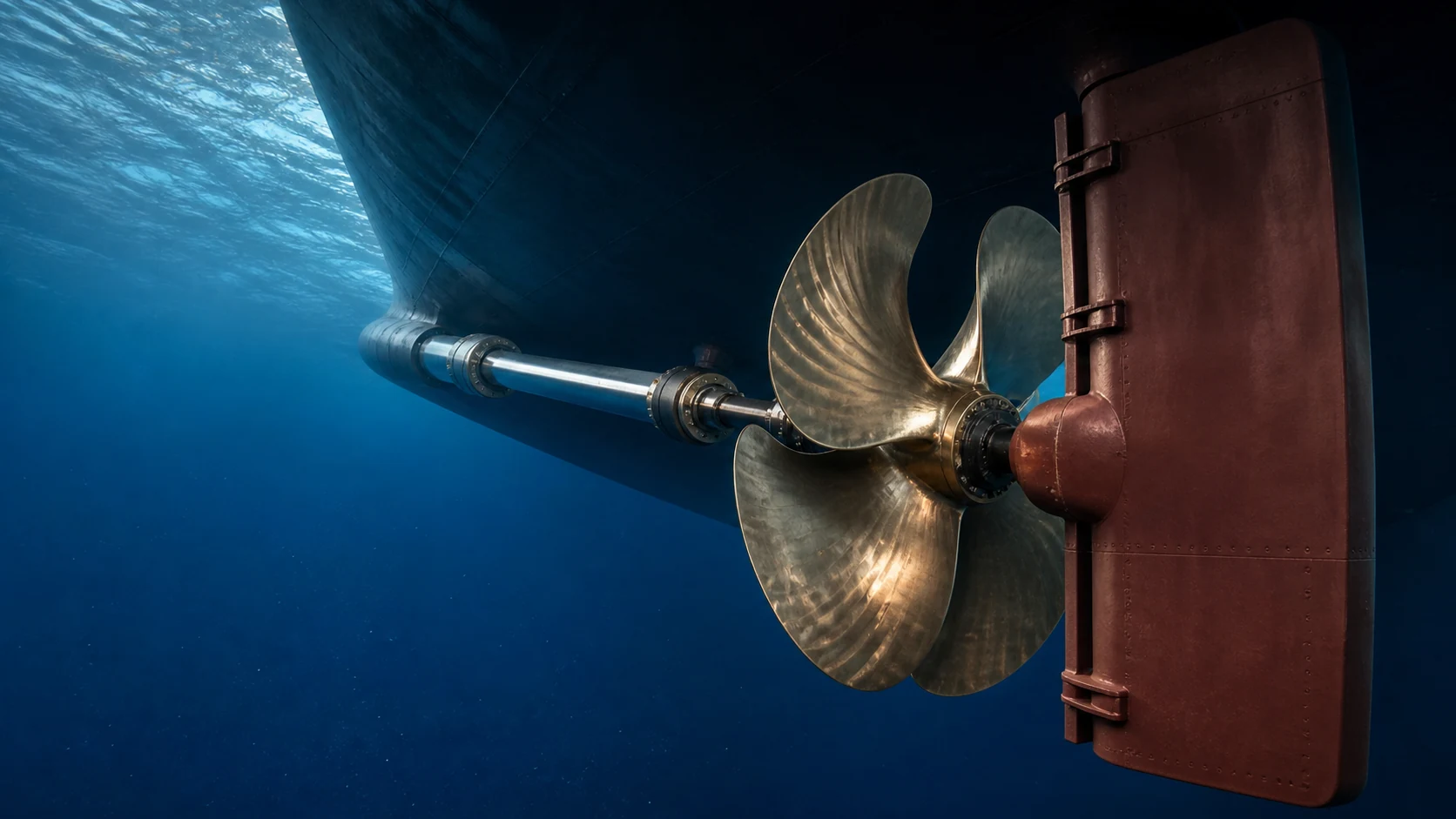
A boat has several sources of vibration: engine, gearbox, shaft and propeller, each with its own frequency. When two or more meet at the same value, resonance occurs and the disturbing forces and vibration grow strongly, making life on board unpleasant and threatening bearings, seals and gearboxes.
The good news: in most cases resonance can be avoided at the design stage by choosing the gear ratio and the propeller blade count together.
How the frequencies are calculated
| Source | Formula |
|---|---|
| Engine, 1st order | engine rpm ÷ 60 |
| Engine, 2nd order | 2 × engine rpm ÷ 60 |
| Propeller shaft, 1st order | engine rpm ÷ 60 ÷ gear ratio |
| Blade passing, 1st order | shaft frequency × blade count |
| 2nd orders | 1st order × 2 |
For a 3000 rpm engine the 1st order is 3000 / 60 = 50 Hz and the 2nd order 100 Hz. No other source on board should produce these frequencies.
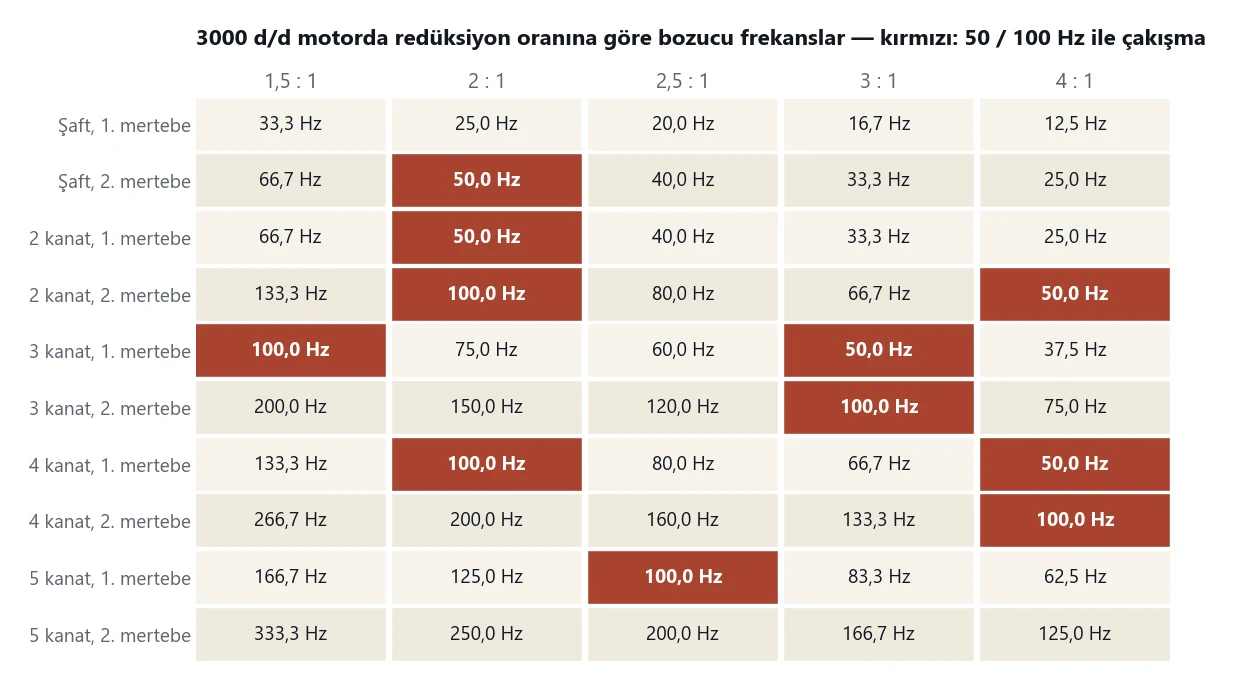
Combinations to avoid with a 3000 rpm engine
| Gear ratio | Avoid |
|---|---|
| 1.5 : 1 | 3-bladed |
| 2 : 1 | 2 or 4-bladed |
| 2.5 : 1 | 5-bladed |
| 3 : 1 | 3-bladed |
| 4 : 1 | 2 or 4-bladed |
With 2:1 and four blades the shaft turns 1500 rpm and the blade frequency is 1500 / 60 × 4 = 100 Hz, exactly the engine's 2nd order. Three or five blades (75 and 125 Hz) avoid it.
The same logic at any engine speed
A blade frequency (1st or 2nd order) meets an engine order when blade count ÷ gear ratio = 0.5, 1 or 2. In other words, a clash occurs when the blade count is half, equal to or twice the gear ratio, which is why 5 blades at 2.5:1, 3 blades at 3:1 and 2 blades at 4:1 are risky. The rule is independent of engine rpm.
What happens at resonance
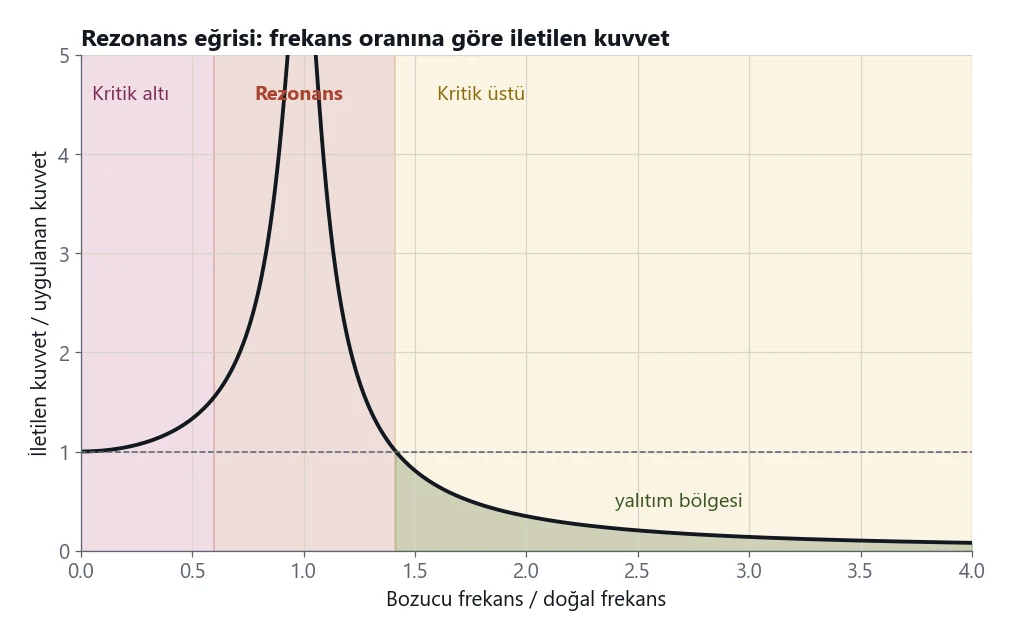
Near a ratio of 1 the transmitted force is many times the applied force; above about 1.4 it is smaller than the applied force and isolation works; below 0.5 it passes through almost unchanged. Engine mounts and flexible couplings are chosen on this principle, but no mount can cure two frequencies clashing at the source.
The cheapest time to fight resonance is while the gear ratio and blade count are still on paper.
Enter your engine rpm and gear ratio in our propeller calculator and check the blade count against this table, or contact our engineers.