
PROPELLER ENGINEERING
Cavitation Types: Where They Form on the Blade and What They Tell You
Where cavitation marks appear on the blade tells you how the propeller is working. Three cavitation types by angle of attack, the vibration and thrust loss they cause and how erosion happens.
- PUBLISHED
- READING
- 4 min
- AUTHOR
- Eriş Pervane Mühendislik
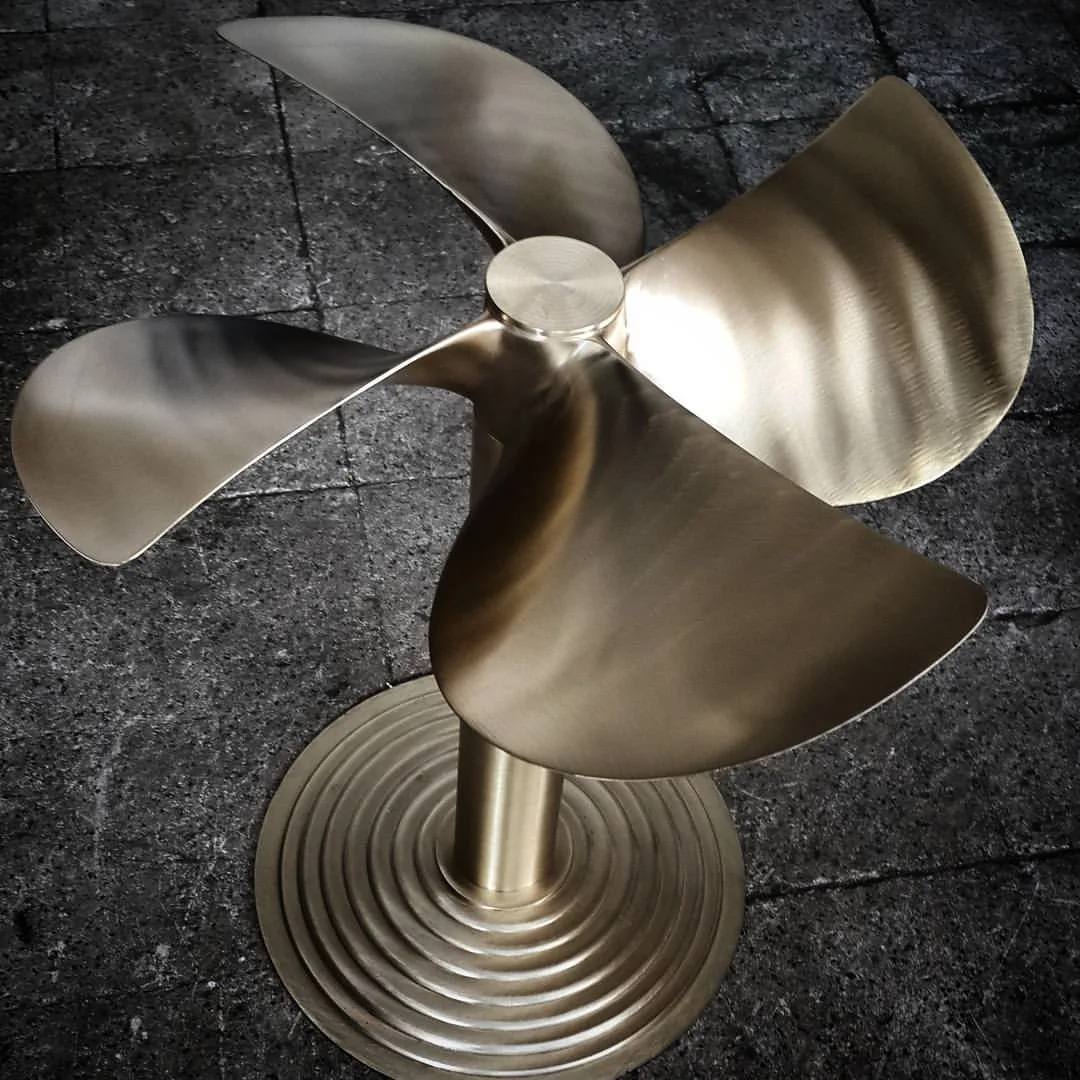
When you lift a propeller out of the water, the bright, rough or spongy areas on the blades are not random. Where cavitation forms on the blade tells you how the propeller meets the water: its angle of attack and its loading. Reading these marks correctly is the fastest way to find causes such as wrong pitch or poor wake.
What is cavitation?
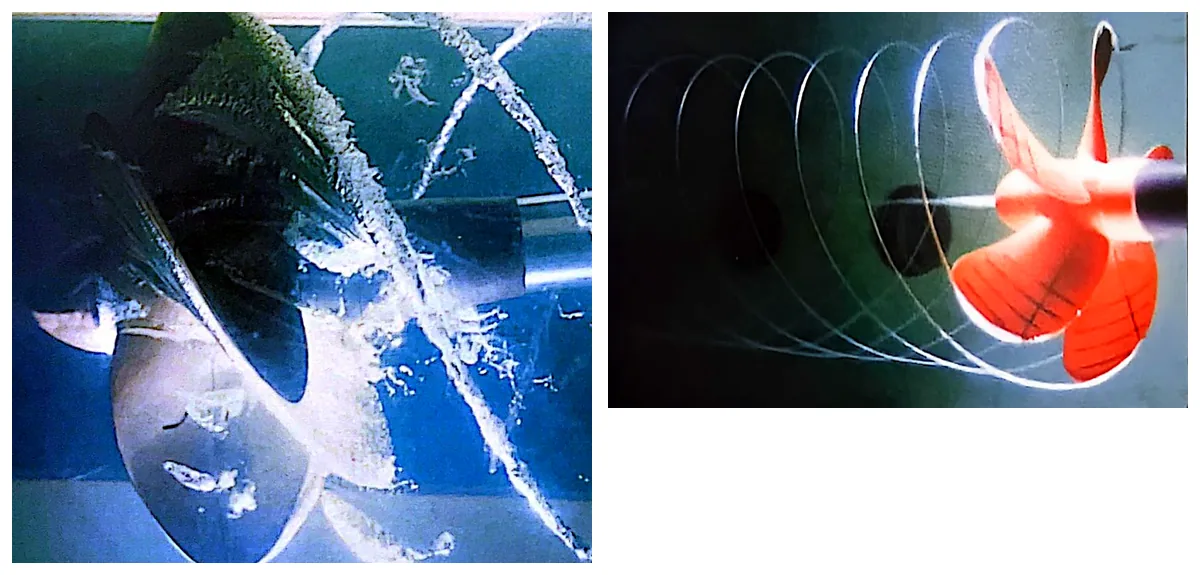
Cavitation, literally "hollowing out", is a hydrodynamic phenomenon that arises in the wake together with the strong turbulence of the rotating propeller. On the blade the water pressure can drop to vapour pressure; the water turns into vapour without boiling and cavities filled with vapour (sometimes partly air) form.
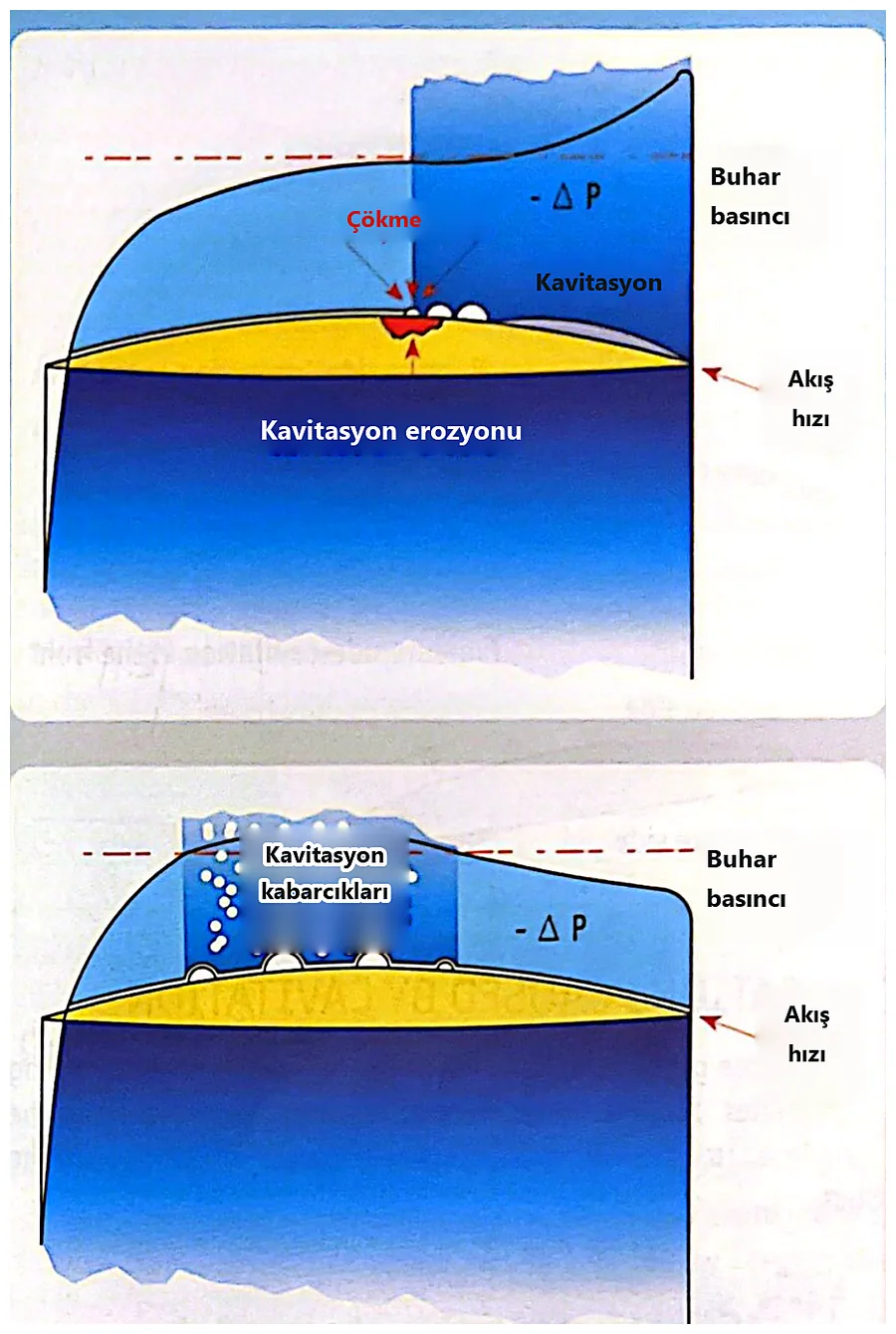
The bubbles are carried into higher pressure and disappear so quickly that we call it an implosion. At its centre, over a tiny area and for a very short time, thousands of atmospheres and thousands of degrees Celsius can occur, acting on the blade like a hammer drill. The chain of consequences: annoying noise, cavitation erosion (accelerated in seawater by galvanic corrosion), loss of balance and vibration, and in the worst case a broken blade.
Three cavitation types by angle of attack
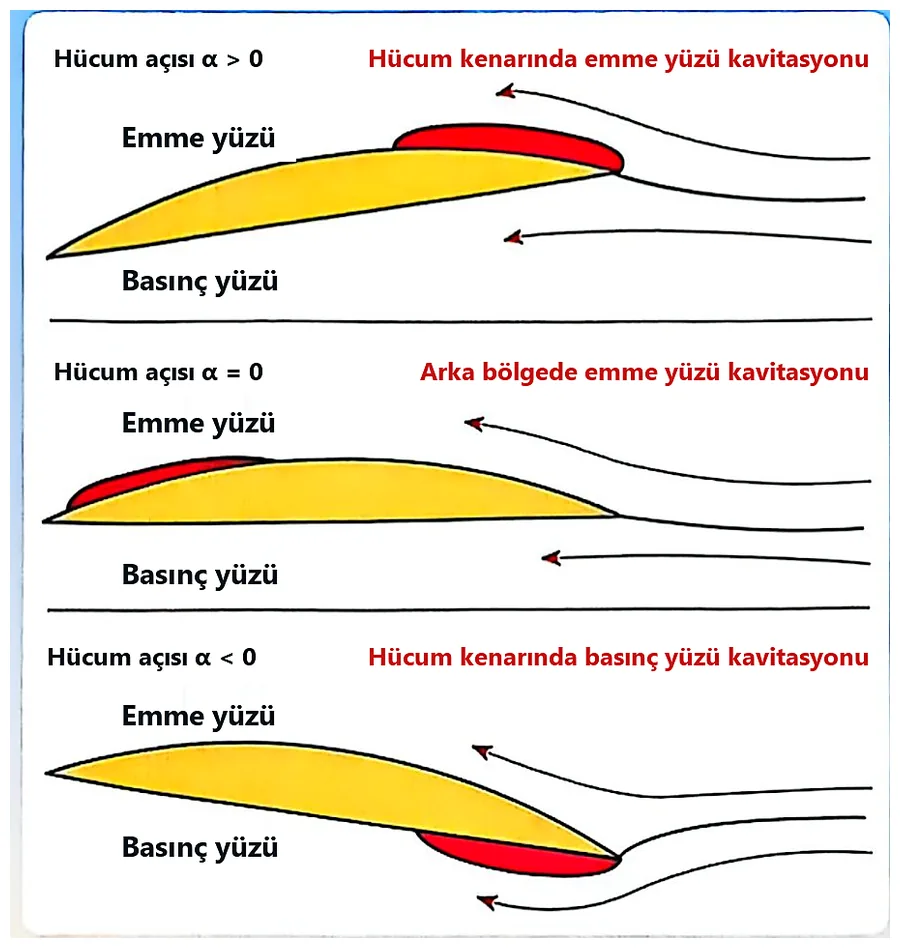
| Angle of attack | Where it forms | What it usually means |
|---|---|---|
| Positive | Near the leading edge on the suction side (back) | Blade overloaded; pitch too high for the local flow or passing a high-wake zone |
| Near zero | Aft part of the suction side | Section thickness and load distribution at their limit for this speed |
| Negative | Near the leading edge on the pressure side (face) | Blade turning too fast for the local flow; low pitch or running above design rpm |
The angle of attack changes on every revolution because the blade meets slow water at the top of the disc and faster water below, so suction-side cavitation often starts as the blade passes the top of the disc. Smoothing the wake is part of fighting cavitation.
Vibration and thrust loss
The cavity volume changes strongly during each revolution, sending strong pressure waves into the hull. When cavitation develops further, thrust can drop sharply; with less torque absorbed, shaft rpm suddenly rises and the engine behaves as if it has lost its grip. That irregular running is itself a source of vibration; fluctuating rpm at full throttle without more speed is a typical sign.
Ways to reduce cavitation
- Keep tip speed below 35 m/s on displacement hulls.
- Increase blade area and choose a wide-tipped contour.
- Use the right section for the speed: sub, trans or supercavitating.
- Choose pitch correctly: back marks often point to too much pitch, face marks to too little.
- Smooth the wake: remove obstacles ahead of the propeller and keep the shaft angle small.
- Leave enough clearance and use skew.
A cavitation mark is not just damage; it is a diagnostic report. First look at where it is.
For repair of eroded propellers see our repair and maintenance page.