
MAINTENANCE LOG
Sacrificial Anodes & Galvanic Corrosion: Propeller Protection Guide
In seawater, bronze propellers and stainless shafts form an active galvanic cell. We explain how sacrificial anodes protect your propeller from pitting and dealloying, along with critical maintenance guidelines.
- PUBLISHED
- READING
- 3 min
- AUTHOR
- Eriş Pervane Teknik Ekip
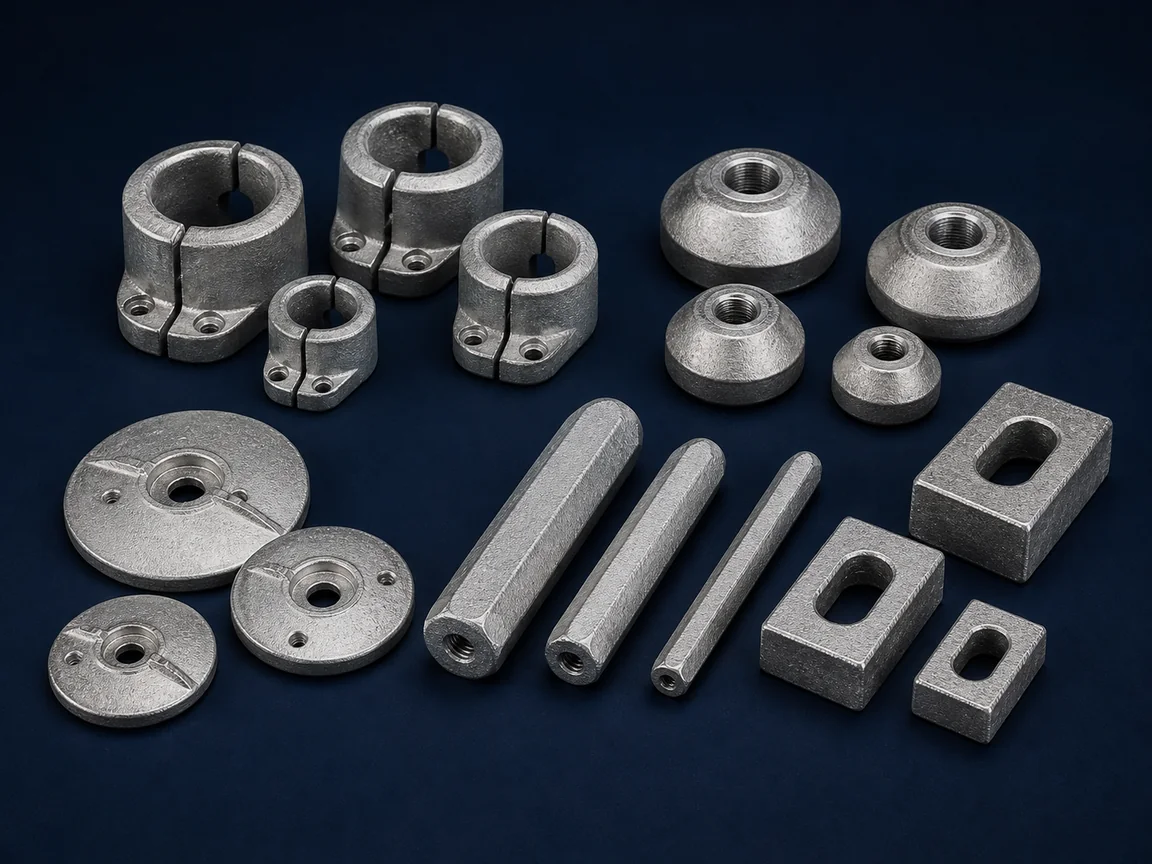
When dissimilar metals such as bronze propellers, stainless steel shafts, bronze struts, and through-hull fittings are submerged in seawater, a natural galvanic cell is established. Saltwater acts as an aggressive electrolyte. In this circuit, the less noble metal continuously sheds electrons and oxidizes. Without effective cathodic protection, this electrochemical reaction causes dezincification or dealloying of bronze, transforming solid blade metal into a porous, brittle, copper-rich sponge.
To shield critical propulsion components from this silent destruction, sacrificial anodes—commonly referred to as marine zincs—are fitted to sacrifice themselves in place of the propeller.
Working principle and anode material selection
Sacrificial anodes possess a more negative electrochemical potential than manganese bronze or nickel aluminum bronze (NiBrAl). When galvanic current flows, oxidation occurs preferentially at the anode, releasing metal ions into the sea while the propeller remains cathodically polarized and intact.
- Saltwater (Marine Environment): Traditional high-purity zinc (MIL-SPEC) anodes deliver optimal, long-term polarization in open seawater.
- Brackish Water (Estuaries / Canals): Aluminum-indium alloys offer wider working potential ranges where salinity fluctuates drastically.
- Freshwater (Lakes / Rivers): Magnesium anodes provide the higher driving voltage needed to overcome freshwater's high electrical resistance (magnesium depletes too rapidly if used in seawater).
The Golden Rule: Never paint, prime, or coat a sacrificial anode. Any insulating layer prevents direct contact with seawater, immediately disabling cathodic protection and leaving your propeller defenseless.
Reading anode wear: diagnosing under- or over-erosion
Inspecting your anodes during mid-season diver checks or annual haul-outs reveals vital diagnostic clues:
- Anode shows zero wear: A pristine anode is a red flag, not good news. It indicates a lack of electrical continuity with the shaft or propeller—often caused by paint, corrosion behind the mounting contact, or poor mechanical bonding. If the zinc is not eroding, the propeller is absorbing the corrosive current.
- Anode depletes prematurely (within weeks): Rapid erosion points to stray-current corrosion, typically caused by onboard electrical leakage or poorly isolated shore-power connections in marinas.
- Optimal erosion rate: An anode that has lost approximately 40% to 60% of its initial mass over a full boating season demonstrates healthy, balanced cathodic protection. Anodes should always be replaced once 50% depleted.
Proper mounting for shaft and propeller nut anodes
Whether fitting collar anodes around the propeller shaft or cone anodes over the propeller hub nut, clean the underlying metal thoroughly with non-metallic abrasive pads to achieve metal-to-metal contact before bolting down the anode. Tighten retaining fasteners evenly with thread locker or lock washers to prevent vibration loosening.
Explore our certified marine zinc anodes in our Shop / Marine Anodes section. For propellers displaying cavitation pitting, dezincification pinking, or blade loss, review our overhaul solutions on the Repair & Maintenance page or consult our propulsion engineering team.