
MANUFACTURING & QUALITY
Propeller Balancing and Vibration: Static vs. Dynamic Balancing
Vibrations felt at specific engine RPMs often originate from microscopic mass center discrepancies in propeller blades. We examine the differences between static and dynamic balancing and their impact on propulsion systems.
- PUBLISHED
- READING
- 2 min
- AUTHOR
- Eriş Pervane Mühendislik
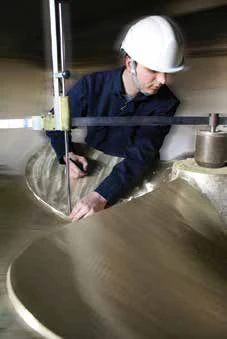
Resonance and vibration felt through the hull at specific RPM ranges represent one of the most common mechanical and comfort issues encountered by boat owners and captains. While operators often attribute this behavior to shaft misalignment or worn engine mounts, the root cause is frequently propeller mass imbalance.
Fundamental differences: static vs. dynamic balance
Propeller balancing is evaluated in two distinct engineering phases:
- Static Balancing: The propeller is mounted on a free-rolling mandrel under gravity to align its center of gravity with its geometric axis of rotation. The heaviest blade naturally rotates to the lowest point. However, static balance only reflects mass distribution at rest or at negligible rotational speeds.
- Dynamic Balancing: The propeller is rotated at calibrated speeds on an electronic balancing rig to measure rotational couples (dynamic moments) across the rotational plane. Even if blade masses appear identical on a static test, axial asymmetries produce rotating centrifugal forces that subject the shaft line to severe radial stress.
A propeller may appear perfectly balanced on a static stand, yet still induce severe high-speed vibration if dynamic couple forces remain uncorrected.
How imbalance damages propulsion machinery
Operating a propeller with uncorrected imbalance degrades mechanical components across the drive train:
- Stern Tube and Cutless Bearings: Radial runout forces the shaft into an elliptical motion, resulting in rapid premature bearing wear.
- Shaft Seals and Packing Systems: Vibration compromises mechanical face seals and deep-sea packing, causing seawater ingress and shaft scoring.
- Gearbox Output and Couplings: High-frequency vibration propagates directly into gearbox thrust bearings, damping plates, and flange bolts.
- Fuel Efficiency Losses: Kinetic energy lost to hull vibration reduces net hydrodynamic thrust, steadily increasing fuel consumption per nautical mile.
ISO 484 tolerances and workshop standards
At the Eriş Propeller manufacturing and finishing facility, propellers are cast, machined, and balanced strictly in accordance with ISO 484 international standards. Blade thickness distribution, pitch coordinates, and dynamic mass balance are certified using computerized test rigs.
If you observe vibration across your current operational RPM range, explore our overhaul capabilities on the Repair & Maintenance page, test your vessel parameters on our Propeller Calculator, or consult our propulsion engineering team directly.